My Family

I created this blog to keep track of my family history research. I do most of my research online.

The Francis name is my husband's which was originally Francisco from Sao Miguel, Azores, Portugal. He also has ancestors from Sweden and England. So far, I have found that my family has come from Italy, England, French Canada, Scotland, and Ulster Ireland (Scotch Irish).

I have also taken a DNA test, which shows mostly Italian, but also England and France.

Wednesday, April 14, 2010

samuel pratt and alithea cushing

Samuel Pratt and Alithea Cushing were my 7th great-grandparents. They were married April 7, 1746 in Weymouth, MA. Looking through the documents available for Samuel Pratt and Alithea, it seems they were probably married at the First Church of Weymouth, North Precinct by Rev. William Smith. They were probably married here as their children's births were recorded from this church as noted in the Weymouth Town records. There is a record of this Church's documents at the Massachusetts Historical Society.

Samuel and Alithea had at least 6 children as found in the Weymouth Vital Records on newenglandancestors.org. They were pretty bold in the names they chose for their children as I have not seen many of these names in other families of this area. Their children were Letitia, Olla, Hannah, Cushing, Tirzah, and Zenas. Tirzah Pratt was my 6th great-grandmother.

According to the book, Genealogy of the Cushing Family by Lemuel Cushing, Alithea's family was one of the first families to settle Hingham, MA in 1638 (p14). Alithea's line would be from Matthew Cushing's son Daniel who arrived in Boston first in 1638. Daniel was given a lot of land in Hingham in 1665. According to a later edition of this book written by James Cushing, p.42 , Alithea's father, Adam Cushing, moved the family to Weymouth to an estate at the corner of Commercial and Essex Street. (In order to officially connect Alithea to Adam Cushing as daughter, I will have to obtain the will noted in this book.) The History of Weymouth book (vol 2, p. 912) states that this house on Commercial Street was sold to Colonel White in 1751, at Adam's death. This would mean that the house that Alithea and her husband Samuel Pratt were living in Weymouth was not that of Alithea's father. Perhaps the land came from Samuel's father or they purchased their own property.

There were many Samuel Pratt's in Weymouth during the 1700's, so I will have to look at the probate records the Pratts to find out who my Samuel Pratt's parents are. According to the History of Weymouth book, Samuel Pratt and Abigail Humphrey are Samuel's parents. The History of Weymouth book (vol. 4 p. 509) also states that Samuel Pratt (supposed father of my Samuel) died in 1744 in Weymouth. The book references Suffolk Probate 37:309 as Samuel Pratt's (father) probate, but does not state how his estate was divided, just that his widow Abigail and son Samuel were granted administration of the estate. Even after I obtain this will, it will be difficult to prove that the Samuel listed in the will is my Samuel who marries Alithea Cushing. As I mentioned before, there were many Samuel Pratt's living in Weymouth, MA at this time. Since Samuel was not married to Alithea at the time of his supposed father's death in 1744, there would be not mention of a wife or grandchildren to identify his son Samuel as this Samuel. I could track all the Samuel Pratt's and their father's probates to exclude other Samuel Pratt's living in Weymouth.

Another way to connect Samuel to his parents would be to find more clues as to where Samuel and Alithea were living. If I know the area and street in Weymouth they lived on, I could see if this land is mentioned in his father's probate. Assuming that Samuel Pratt and Alithea are still living in 1790, I searched the 1790 census to get a sense of where they lived in the town. In Weymouth, there are two Samuel Pratt's listed as head of household, both with one male and one female. One Samuel is listed as living near other Pratt's, which is most likely the Samuel that had 4 sons mentioned in the History of Weymouth book (vol. 2 p. 909). The other Samuel seems more likely to be Samuel and Alithea, living next to Frederick Lincoln, Joshua Witmarsh, and near Joshua Bates, ? Porter, Elik Witmarsh, Tho Gould, and Asa Dyer. All of Samuel and Alithea's children, except Zenas, were married by 1790. Since there is only one male listed in the 1790 household, Zenas is not living with them. There is no other listing for a Zenas Pratt in Weymouth; maybe he is living with one of his sisters or his brother Cushing. Cushing Pratt is not listed in the 1790 census in the town of Weymouth either. I am not sure where these brothers are in 1790, but it does seem they ended up in Maine later in their lives (from Rev. War Pension and census).

Since the 1790 Census for Weymouth seems to list the families in order of when they were enumerated, the people listed near Samuel Pratt would probably have been his neighbors. Samuel and Alithea's oldest daughter, Letitia married Ezekial Whitmarsh. There is an Elik Whitmarsh living near Samuel Pratt, perhaps this is Letitia and her family. By 1790 Letitia had 5 daughters and 1 son. The 1790 Census has 2 of those daughters and the son living in the same household. I am not sure this family matches up as they would be missing 2 daughters (their oldest was married in 1790) in the household. It does not seem that any of her daughters died before 1790 either, according to the Weymouth Records. Another daughter of Samuel and Alithea was Olla, who married a Joseph Peaks. After quickly searching for any Peaks in Weymouth, I did not come up with any, so I am not sure where Olla was living either. Olla and her husband did have a daughter born in Weymouth in 1788, so they still could have been in Weymouth in 1790, perhaps living with a sibling also. Samuel Pratt's third daughter, Hannah, married Abraham Bates. There is an Abr Bates living in Weymouth, but enumerated on a different page. This Abr Bates has 2 females and one male, which matches up with Hannah's family of one daughter. The Abr Bates family is linked in the census to an Eph Pratt. (who is Eph Pratt). Samuel and Alithea's fourth daughter, my 6th great-grandmother, Tirzah Pratt married Joshua Bates (Abraham Bates' brother - vol3 p. 26), who is living near her father Samuel Pratt. They have 1 male under 16 (Joshua), 1 male over 16 (Joshua) and 4 females (Tirzah, Nancy, Cynthia, ?) living in the household. There is one un-accounted for female, which could be another daughter not listed in the town records, or Joshua Bates mother. I am not sure when Sarah, Joshua's mother, died, but her death is not listed in the Weymouth Town Records or the Hingham Town Records. Neither is Joshua's father Abraham. (Abraham was from Weymouth and wife Sarah Tower was from Hingham). The census gave me some clues as to who Samuel and Alithea's neighbors were, now I will take a look at a map of the area to pinpoint a location.

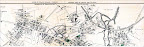
The Weymouth Map of 1876 on ancestry.com is helpful in locating what part of Weymouth Samuel and Alithea Pratt were living. Even though it is about 100 years later, the map shows the residences of many of the descendans, giving a good idea where their land and houses came from. The History of Weymouth book, with the chapter on century old houses, also gives us information as to who lived where. Putting all these resources together with the town records and the census shows that Samuel Pratt and Alithea Cushing Pratt were probably living in East Weymouth, in the area that the Immaculate Conception Catholic Church and the Middle School on Commercial Street are now located.


Map of East Weymouth, MA 1876
From May 2010


The map above shows who was living in East Weymouth on Commercial Street in Weymouth in 1876. The History of Weymouth book, on page 918, vol. 2, gives a list of residences for this same area in the early 1800's and also who lives there when the book was published, in late 1800's to early 1900's. The book does not mention Samuel Pratt, but it does mention Joshua Bates, who lives near Samuel Pratt in the 1790 census. The book also states that Francis Cowing (Joshua's grandson) is living at this residence by the late 1800's. The Weymouth map above shows us the location of Francis Cowing's residence, and therefore Joshua Bates' residence around 1790. Samuel was living in this same area in 1790. The next step would be to locate deeds for Suffolk County and Norfolk County for Samuel Pratt to gain more information on his land and where it came from and who it was sold to. Samuel's probate record would provide more information also. There is a probate record for a Samuel Pratt for 1794 which could be his, indexed in Norfolk County Probate Index on ancestry.com, Will Case Number: 15128. (Norfolk County was created in 1793). I have not been able to find any record of Alithea's death.

The History of Weymouth book also mentions some other Pratt's that were living in this area in the early 1800's. The first mentioned is John L. Pratt, which is not closely related to Samuel Pratt. He did have many children who are listed as owning property on the 1876 map, across the street from S. Healy and E. Bass. The next Pratt mentioned on this page is Capt. James Pratt. James Pratt's father (Matthew) was Samuel Pratt's brother (so James was Samuel's nephew). Since I know from the 1790 census that Samuel also lived in this area, perhaps he and his brother Matthew lived next to each other, maybe on land handed down to them from their father. (The History of Weymouh book does state that Samuel and Matthew's father Samuel Pratt lived in the South Section of Weymouth though). I will have to find the Norfolk deeds for their property. It also seems that Samuel did not hand down his land in this area to his children as their descendants are not listed on the 1876 map of Weymouth in this area.

I did look into the other names listed on the 1876 map to see if there were some connections to Samuel or Matthew Pratt. The area that seems to match the description in the History of Weymouth book for James Pratt looks to be the land where Q. Randall and E. Nickerson are located. Quincy Randall does not seem to have a connection that I could find. He is listed on the census as living alone, and in the History of Weymouth book it is stated that he left his estate to cousins, so it appears that he does not have children or a wife. Edmund Nickerson does seem to have a connection to the Pratt's. I traced his lineage using the History of Weymouth book (4_524). Edmund married Matthew Pratt's great-granddaughter, Lydia Bicknell (Lydia Pratt Bicknell, Joshua Pratt, Matthew Pratt). This land could have been James Pratt's land handed down through the family, or separate land that was given to her grandfather Joshua (James' brother) through his father Matthew. Perhaps then Samuel (my ancestor) and his brother Matthew did receive land from their father Samuel Pratt.


to do list
1. obtain adam cushing's will proved 1752 weymouth to prove alithea's parentage
2. abstract of will for matthew cushing (mentioning daniel cushing) located in nehgr 1856 10 p.173
3. james cushing's book states that daniel's will is published in nehgr 13 p. 293, but i did not find it there - i searched for daniel cushing up to vol 46 and did not find his will
4. find abraham bates and sarah tower bates death - probate
5. find grave/tomb of joshua bates (elder) - history of weymouth books states it is on a hill nearby his home (francis cowing home - now weymouth middle school)
6. find norfolk deed for samuel pratt and alithea

topics of interest
1. cushing family from history of hingham on google books here p 150
2. daniel cushing wrote - Early Settlers of Hingham. Extracts from the Minutes of Daniel Cushing 3. adam cushing said to have started the herring run - google books Proceedings on the two hundred and fiftieth anniversary of the permanent ... By Charles Francis Adams, Weymouth (Mass.) p 49
4. lineage of cushings from Historic homes and places and genealogical and personal memoirs relating to the families of Middlesex County, Massachusetts, Volume 2 - page 693

Antonio and Angelina Pompeo april 6

I recently blogged about Antonio and Angelina Pompeo when I found their marriage record on pilotfamilysearch.org in February. Since their anniversary was April 6, I thought I would write a little more about their lives together.

Antonio and Angelina* were married 99 years ago, on April 6, 1911 in Boston, MA, by Father John Vitale at 15 North Bennet Street. This is the address for St. Leonard Parish in the North End section of Boston. It seems that they were living in Quincy, MA at the time, so I am not sure why they were married in Boston, perhaps it was the only church that held mass in Italian. According to the 1910 census, Antonio was living with a Joseph Pompeo as boarders at 41 Union Street in Quincy, MA. Angelina did not come to the United States until February of 1911. Her passenger record (page 2) states that she was going to live with her brother Cristoforo Gagliardi at 41 Union Street, Quincy, MA. Since Angelina and Antonio were married only 2 months later and her brother was living with her future husband, it seems likely that they knew each other in Italy before Angelina came to the United States. Antonio and Angelina both came from the same town in Italy also, Torre De Passeri. If they did know each other, they probably had not seen each other for about 6 years since Antonio had been in the United States since 1905 (Antonio's passenger record). Angelina would have been 19 years old when Antonio left Italy. It is possible that Antonio traveled back to Italy during this time for visits home with his family, I will have to search for more passenger records for him. I did not find much information on the the commune of Torre de Passeri, other than it's location on the eastern part of Italy in the province of Pescara in the Abruzzo region, considered Southern Italy. As I could not find much information on Torre de Passeri, I would assume it must be a small commune in Italy.

By September of 1918, when Antonio registered for WWI, he and Angelina were living at a new address of 24 Alden Street in Quincy, MA. Antonio was working as a laborer at the Fore River Company on Howard Street in Quincy, I am guessing this was the Quincy Shipyard, where many of the people from the area worked, including my father. By 1918, they had 4 sons, the youngest was my grandfather Armedio. Antonio and Angelina had 2 more children by 1922, both girls. My father remembers that two of their children, Leo and Dorothy, died of Hodgkins Disease.

The 1920 Census lists Antonio, Angelina and 5 of their 6 children living together on 24 Alden Street in Quincy, MA. Also living on their street is Dominic Pompeo and his wife Secondina with their daughter and two sons. Secondina is Angelina's sister according to the Quincy Vital records on pilotsearch.org. Dominc and Secondina's family also has their brother-in-law and sister-in-law with a son living with them. The census is difficult to read, but it looks like the brother-in-law's name is Dominic Gizzarelli, who came to the United States in 1910. The sister-in-law's name might be something like Giacindo who came to the United States with her son. (My Dad said he thinks they called her Georgina). I did find Geocinda and her son's passenger record (page 2), coming to see her husband Dominic Gizarelli in New York in 1916 (by 1920 though, they were in Quincy). These in-laws would be Secondina's sister and husband, and therefore Angelina's sister as well. I do also know that Angelina had a brother Cristoforo who came to the United States in 1901 and was also married to a Pompeo, Odelina. Cristoforo and Odelina were marred in Italy according to her passenger record. I am grateful for these records, as they allowed me to find that Angelina had at least 2 sisters (Geocinda and Secondina) and one brother (Cristoforo) living in the same town of Quincy. I am sure it was a comfort to Angelina to have her siblings living so close, as it must have been difficult living in a new Country so far from home.

Antonio also had a least one sibling, Joseph Pompeo, living in the United States. There are other Pompeos in Quincy at this time, including Dominic (Secondina Gagliardi's husband), Odelina (Cristoforo Gagliardi's wife) and Raffeal, who came to the US with Cristoforo Gagliardi in 1901. On Dominic Pompeo's passenger record, it states that Raffael Pompeo is his uncle. I do know that Dominic Pompeo was not Antonio's brother, as he lists different parents on his marriage record in Boston, MA. Dominic's parents are Felico Pompeo and Carmela, Antonio's parents are Croce Pompeo and Elisabetta. There are many other Pompeo's living in Quincy in 1920, in all there are 33 Pompeo's. I am not able to see how many originated from Italy or are heads of households at this time as I do not have a subscription to ancestry.com. The records that I had searched in the past though do allow me to find that Cristoforo Gagliardi and his wife Odelina Pompeo were the first to come to the United States, he in 1901 and she in 1903. Cristoforo came with 4 other men from the same town of Torre de Passeri, Raffeal Pompeo being the oldest at age 43, Berandino Di Lorenzo next at age 41. As these men are a generation before Cristoforo, maybe they are his or Odelina's Uncles (Cristoforo's mother's maiden name is Di Lorenzo). If Raffael is Odelina's uncle, then Dominic Pompeo would be Odelina's brother. However, right now I just do not know how Dominic is related to Odelina or Antonio. Even if they were not close relatives, they certainly all knew each other coming from the same town in Italy. Again, I am sure there travel was made a little easier knowing others from the same part of Italy as they lived. (see to do list 5 and 6 below for update)


View Pompeo Family 1920 in a larger map


Antonio Pompeo lived at 24 Alden street until his death sometime before 1930.  The 1930 census has Angelina Pompeo as the head of household on Alden Street with all 6 of her children. In 1930, her oldest child, Crosie, was 16 and her youngest, Rita, was only 7. It must have been very difficult for her to be alone and caring for 6 children. According to this census, Angelina owns her house at a value of $5,000. The census also states that she is not able to read or write and she is not able to speak English. I find it surprising she was not able to speak English, as she had been living in the United States now for 19 years. Also by this time in 1930, she is naturalized. I did not find her naturalization record on footnote.com, and I am not sure if she was automatically naturalized because her husband was naturalized before he died. I will have to look through the naturalization laws at this time. I did not find Antonio's naturalization record either.

Since Angelina was raising her children alone in 1930, I looked into where her relatives were living at that time to see if she may have had some support. All of her siblings were living in Quincy in 1930, her brother Cristoforo Gagliardi was living at 36 Newcomb Street, her sister Geocinda was living at 29 Main Street. Secondina was living the closest to Angelina at 34 Lowe Street, probably giving her the most support.


View Gagliardi siblings 1930 in a larger map


Those are the last of the records I have for Angelina and Antonio. Their lives must have been very challenging, coming to a new country, speaking a different language and trying to adjust to a new lifestyle. Having their extended family around them was probably very comforting, especially to Angelina once her husband died young in his 40s.


notes:

*the passenger record and the marriage record state her name as Angela, not Angelina. When I first came across her name in the 1930 census, it stated Angelina, which is what I tend to use. Antonio's WWI registration card also states her name as Angelina.

to do list:

1. find naturalization records for antonio and joseph pompeo - and other pompeos - raffeal
2. find wwi record for joseph pompeo and raffeal pompeo - other pompeos. UPDATE: Joseph's WWI record is filed under Guisseppe Pompeo.
3. find marriage record for joseph pompeo - he is single in 1910. another joseph may have married a lauruno fertilli - this couple had a daughter avelina who b. 1914 and d 1915 - antonio's brother joseph in 1920 census has wife cristina - there are two joseph pompeo's in 1910 census in quincy (one born 1880, antonio's brother is born 1890) other joseph is married to laura fertilli.  UPDATE: Joseph - also named Guisseppe - marries Cirettina Gramazio in December of 1916 in Boston, MA, according to familysearch record.  States same parents as Antonio, Croce and Elisabetta.
4. find other passenger records for antonio pompeo to see if he went back and forth to italy and united states
5. find relationship between all the pompeo's that the gagliardi's married - antonio pompeo, dominic pompeo and odelina pompeo is odelina antonio and joseph's sister - odelina may have died before 1927 as cristoforo gagliardi is married again in 1927.  UPDATE: family search has posted these italian records online for Torre de Passeri and I was able to answer all of these relationship questions.  Odelina = Adelina ; she is the sister of Antonio and Joseph.
6. Dominic pompeo - lists uncle raffeal pompeo on his passenger record. the raffeal pompeo that lives in quincy in 1920 would make sense as uncle as he was born in 1858. (raffeal pompeo and cristoforo gagliardi came over to NY together with three other men from torre de passeri in 1901) maybe raffeal, felice and croce pompeo are brothers - also a luigi lists raffeal as his brother (felice and luigi seemed to have come to us - but they are not listed in any censuses - maybe they died or went back to italy) UPDATE: family search has posted these italian records online for Torre de Passeri and I was able to answer all of these relationship questions.  Raffael, Felice, Luigi, and Croce are all brothers, sons of Domenico Antonio Pompeo and Concetta Calderelli.  They also have a sister Giovanna - but did not find records of her in US, maybe she stayed in Italy or died young?)
7. find passenger records for the pompeos that live in Quincy in 1920 census - any siblings of Antonio.

Monday, April 12, 2010

george lane french revisited

After looking through the information and records available through the History of the Town of Hingham book and the Hingham and Weymouth Vital Records, I thought it would be good to put down some of the conflicting information on George French's family to keep track of it all.

According to the Hingham book, George Lane French had a son George who marries, first a Delight Rice in 1785, and secondly an Anna Rice in 1791. There seems to be two George French's around the same age at this time though, as the Hingham vital records has another George, with a middle name of Lincoln, marrying a Sally in December of 1790 and then a Betsey in 1804. So in 1790 there should be three George French's living in either Weymouth or Hingham; George Lane, his son George, and the George Lincoln French. I have no proof as to which George is George Lane's son, other than the Hingham book which states the George who marries Delight and Anna is George Lane French's son. The other George is not mentioned in the Hingham book at all.

The census for 1790 only has one George French, living in Hingham, that I have found. This George's family includes the following; 2 males under the age of 16, 1 male over the age of 16 and 2 females. As I mentioned in a previous post, this George does not seem to match the family of George Lane French. It also would not match the George who married Sally in December of 1790, as he would not be married and have children at the time of the census in April. This George in the 1790 census is probably the George who marries Delight Rice in 1785, as according to the Hingham book, they have 2 sons by 1790 under the age of 16 and one daughter. The other two people listed on the census would be George and his wife Delight. I should note that I did not find records of George and Delight's children in the Hingham records on newenglandancestors.org. The vital records of Hingham do show, however, that George's wife Delight and his son Phinneas, both die in 1791 at the almshouse in Hingham.


George Lincoln French is not listed in the 1790 census, probably because he could still be living with his parents (whoever they are) as he did not marry until December 1790. George Lane French is not listed either as a head of household in 1790, even though he is still living, most likely in Hingham. He could either be living with one of his children or already at the almshouse in Hingham, where he dies in 1814. I know from the Hingham Vital records that George and Sarah had at least three sons, Joshua, George and Nathaniel. The Hingham history book states they had 6 sons and one daughter (Phinneas, Theodore, Perez, and Sarah d. as infant). Let's say that George in the 1790 census is George Lane's son, we would know that his father is not living with him as there is not another male over 16 listed in the family.

George's first son, Joshua was born in 1764. I did not find him in the 1790 census, nor did I find any vital records of marriage or death in the Hingham or Weymouth records. The History of the Town of Hingham book has Joshua's death on August of 1778. If he does die in 1778, he obviously would not be listed on the 1790 census. There must be some church or town records that The Hingham author used for his data that I have not found yet.

I next looked at George's son Nathaniel, my 5th great grandfather. Nathaniel does not marry until 1797, but he is 22 years old in 1790, which means he could be living on his own. He is not listed in the 1790 census in either Hingham or Weymouth though. On another note, I want to address the possibility that Georges' son Nathaniel may not be "my" Nathaniel that marries Sally Chubbuck. I came to the conclusion that Nathaniel's (my 5th great-grandfather) parents were George Lane French and Sarah Tower through possible birth dates I obtained for Nathaniel trough the censuses. Using the 1800 and 1810 census for Nathaniel, he would have been born between 1766-1774. I then looked in the Hingham vital records for a Nathaniel born between those years and there was only one listed, the son of George Lane and Sarah, who was born January 19, 1768. I came to the conclusion that this is most likely my Nathaniel French. There is also a death record for a Nathaniel French for 1818. The records indicate that this Nathaniel would have been 42 when he died, which would not make sense for the age of Nathaniel if he were born in 1768. If this record is correct, the Nathaniel that dies in 1818 would have been born around 1776, which is too late for my 5th great-grandfather, who was probably born between 1766-1774. If my Nathaniel died in 1818, he would be about 52 years old. The Hingham records that I have access to on newenglandancestors.org were transcribed, which could have resulted in a transcription error, perhaps it does say he was 52 years old at death, and not 42. It is also important to note that the History of the Town of Hingham book lists my great-grandfather's death in 1819 at the age of 52, which makes more sense. I will have to find the original record of death to see which is the correct date for additional proof that I have the correct parents for Nathaniel. (I am not sure if it was recorded at the town or at a church). This death date of 1818 or 1819 does make sense for Nathaniel who marries Sally Chubbuck as his wife is listed as widow in the 1820 census. So there is some question as to Nathaniel's parents, but judging from the census information, it seems likely that they are George Lane French and Sarah Tower. I would like to find more of a connection between Nathaniel and George Lane French, possibly through probate and land records of Jonathan French (George Lane French's father) or Sarah's father, Nathaniel Tower.

Getting back to George Lane French's location in 1790, it is also important to look at his other sons that are stated in the Hingham book. Looking at their ages in 1790 though shows they would probably be too young to be listed as a head of household in the 1790 census. We still have not found where George Lane French and his family are all living at this time. As I mentioned earlier, it could be possible that they are in the almshouse by 1790, which would mean we would not find George in the census. There are a couple of more options to explore for George's location in 1790 though; his parents, parents-in-law, and brothers.

I checked to see if George's father or father-in law were living in 1790. However, George's father Jonathan died in 1780 and his father-in-law, Nathaniel Tower, died in 1767 according to the Hingham book. George Lane French also had two brothers that could have been helping him at this time. I found in the Hingham vital records that George had a brother Theodore born in 1744. According to the Hingham book, Theodore is still living in 1790 with a wife, a son and a daughter. Theodore is listed in the 1790 census in Hingham, MA. Unfortunately, I have let my subscription to ancestry.com lapse, so I am unable to see who is listed in his household. George had another brother, according to the Hingham book. The book names a Jonathan who was born about 1753 and marries in 1776. (I did not find his birth in the Hngham Vital records on newenglandancestors.org). There is also a Jonathan French listed as a head of household in the 1790 census for Hingham, which I will have to look at once I renew my subscription to ancestry.com. Jonathan and his wife would have had 4 boys and maybe 2 girls when the 1790 census was taken. It is also important to note that the Hingham book states that both Theodore and Jonathan reside on French Street, the same street that George Lane French's father Jonathan resided on. Perhaps their father Jonathan gave his property to his two sons, as George had already moved out and had his own land at the time of his father's death. The book states that George Lane French resided on Hersey Street. Also, George Lane French's son, George, who is listed in the 1790 census is not on the same census page as his uncles Theodore and Jonathan French.

to do list:
1. find where hingham book obtained information on George Lane French's family - church records maybe (Check out Peter Hobart's journal, published in NEHGR 121(1967):3-25, 102-127, 191-216, 269-294 - peter was the minister of the old ship church - although these records seem to end in 1688 http://dunhamwilcox.net/ma/hingham_ma_marr.htm)
2. find where George and his possible sons are buried - maybe with father/grandfather jonathan french - where is he buried
3. find almshouse records
4. find probate of nathaniel tower (d. 1767) and jonathan french (d. 1780 no probate listed in hingham book) see if they list grandchildren or george lane french and sarah tower french.  Hingham was in Suffolk County until 1793. (UPDATE: index online for suffolk county probate, P-Z; no nathaniel tower - some sarah towers.  The index for A-F is not available online yet, so could not check for Jonathan French)
5. look at 1790 census for brothers theodore and jonathan to see if george lane and his family could be living with them

Wednesday, April 7, 2010

george lane french

George Lane French, one of my 6th great-grandfathers, was born on April 4, 1741 in Weymouth, MA, as listed in the Weymouth Vital Records. His parents were Jonathan French and Jael Beal. The History of the Town of Hingham book states that George was baptized July 11, 1742 in Hingham, MA. His family must have lived in Weymouth at the time of his birth, but he eventually found his way to Hingham.

It seems that his family originally settled in Weymouth, but moved back and forth between Weymouth and Hingham, MA throughout the years. I have been able to find some information on George Lane French. The records I have found for him almost always list his middle name of Lane. Perhaps this was to distinguish him from other George French's in the area, or maybe the middle name has some important significance to the family. I did find George Lane French noted in a Lane geneaology book as listed in the will of Elizabeth Stowell Lane. George's mother, Jael French, is listed in Elizabeth's husband (George Lane)'s will.

I was not sure what the connection was to this Lane family, so I started to trace Jael's family back to see if there were Lanes on her ancestry. Using the following book, the History of the Town of Hingham, vol. 3, p 126 and p. 216 , it seems that Jael is the daughter of Elizabeth's Stowell's neice, as follows: Samuel Stowell and Mary Farrow have the following children...Mary, Samuel, John, David, Remember, William, Isreal, Elizabeth and Benjamin. Elizabeth is the woman who lists the French's in her will. A sister of Elizabeth's, Remember, marries Thomas Remington and they have Jael Remington (neice of Elizabeth Stowell Lane). Jael Remington marries Thomas Beal who have Jael Beal (daughter of Elizabeth's neice). Jael Beal marries Jonathan French and they have Abigail, George Lane, Theodore, and Hannah. As noted above, Jeal is mentioned in George Lane's will (Elizabeth's husband), and Jael's children are mentioned in Elizabeth's will. It seems like a distant connection to benefit from someone's will, but I am guessing Elizabeth and George Lane did not have children of their own and became close to this family and their children. After all, Jael and Jonathan French did name their son after George Lane.

I did find one other connection that George's mother Jael Beal may have had to Elizabeth Stowell Lane while reading through the Beal geneaology in the History of the Town of Hingham, vol. 2, p 54. Elizabeth Stowell Lane's mother Mary married secondly Joshua Beal (both widows). Elizabeth was only 16 years old, so Joshua Beal could have been close to Elzabeth, like a father. Joshua Beal is Jael's father's uncle (so Joshua Beal was Jael Beal French's great-uncle). I am sure that Jael and Elizabeth had a relationship due to this second marriage of Elizabeth's mother.

Getting back to George Lane French now, his first wife was Sarah Tower, married November 14 1762 in Hingham, MA. According to the History of the Town of Hingham, George and Sarah had 7 children together. Their first son, Joshua, died when he was 14 years old, and their last child, Sarah, died before she turned 1. I found records for only three of the children in the Hingham Vital Records. George's first wife died at a young age of 40, in 1783, only three months after she had her last child, Sarah.

Between the birth of his 6 children and the last child, Sarah, George enlisted for a very short time in the Revolutionary War. According to Massachusetts Soldiers and Sailors in the War of the Revolution, "French, George Lane. Private, Capt. Pyam Cushing's co., Col. Lovel's regt.; service between March 11 and March 29, 1776, 2 days; company assembled to guard the shore." I searched for a pension file on footnote.com, but there were not any George French's from Massachusetts that filed a pension. I also searched for service records on footnote, but was not able to find any.

After Sarah's death, George married a second time in 1783, to Abigail Lewis. This marriage also ended with his wife's death in 1790. George then married a third time, in 1791, to Fanny James Humphrey. The History of the Town of Hingham book states that this family resided on Hersey Street in Hingham.


I searched the 1790, 1800, and 1810 censuses for Hingham and Weymouth for a George French. I was able to find a Geo. French in the 1790 census, listing in the household 2 males under the age of 16, 1 male over the age of 16 and 2 females. If we match these numbers up to the children listed in the History of the Town of Hingham book, we would have Perez under the age of 16, but Theodore would be about 18 years old. Of course, George Lane would be the male over 16. We still need to account for two females. One of the women living in this household in 1790 could be George's second wife Abigail, although she died in April of 1790. According to a wikipedia entry, the census was taken after she died, in August of 1790. That still leaves us with two females unaccounted for in this household. According to the vital records and the Hingham book, George did not have any daughters except Sarah, who died around 1782. This family does not seem to match up to George Lane French's family very well. I will have to check if there is another George French living in this area in 1790. (George does have a son George, but he does not marry until December of 1790.) The options left for George Lane French would be he was living with one of his sons or he was already living at the almshouse, which did not list residents in the census at this time. My next step will be to track George's sons in the census. I also did not see an entry for a George French in the 1800 or 1810 census in this area.

As stated in the excerpt above and in the Hingham Vital Records, George died on May 12, 1814 at the age of 72. The records of Hingham also state that both George and his 3rd wife Fanny died at the Almshouse in Hingham. The following is a passage in the History of the Town of Hingham, describing the almshouse in Hingham for the period that George and Fanny may have lived there.

I am not sure if the town's records for the meetings still exist, but they may provide names of the poor that were living at the almshouse. This would be interesting to see when George and his wife had to gain the support of the town.

to do list:
1. find records for George Lane French and Jael Beal French's children
2. find town records - may have information on almshouse
3. find where George and his three wives were buried - were George and Fanny buried separately as they died at the almshouse.
4. find if other George Frenchs would be living in this area in 1790 to match them up to the Geo. French entry on the census. update - found 3 possible george's living in 1790 - the one listed in census is probably george lane french's son george who marries delight rice - see next post
5. track George's sons through the census, see if he could be living with them. update - george not living with children - see next post

revolutionary war - samuel bates

Samuel Bates, a 5th great-grandfather of mine, fought in the revolutionary war from 1775 until 1778. Samuel was from Weymouth and enlisted in Weymouth during these years. He states in his pension that he was not involved in any battles, but did a lot of marching to and from different parts of the country. He also spent the latter part of the war carrying goods as a teamster from city to city. The pension file also allowed me to find Samuel's parents names from his birth date listed on the pension, and gain some other personal information. Samuel spent almost three years helping his country, I am glad to have some record of it.

Samuel first enlisted in May of 1775, a month after the battles of Lexington and Concord. This term of service lasted until January of 1776 as a private in the Massachusetts Militia under the command of Capt. Jacob Gould in Col. Greaton’s regiment. During this term, Samuel "marched from Weymouth to Boston was stationed there through the vicinity the whole term: that he served at Cambridge with a portion of the regular troops; and Gen. Washington, General Heath, and General Putnam regular officers were known to him: that he was in no battle." According to the Wikipedia article on the Massachusetts line, Greaton's regiment was part of the Seige of Boston, "The 21st Massachusetts Bay Provincial Regiment was commanded by Colonel William Heath, of Roxbury. Heath was made a Continental brigadier general on June 22, 1775, and command of the regiment passed to Lieutenant Colonel John Greaton. Greaton was promoted to the rank of colonel on July 1, 1775, and the regiment became Greaton’s Regiment. In August 1775, Greaton's Regiment was designated "The 36th Regiment of Foot." It served in the Siege of Boston until its disbandment." The reference given for wikipedia's information is the Historical Register of the Officers of the Continental Army..., which can be found on google books. There is also an article in Massachusetts Magazine on this regiment, referenced in my to do list below, which I will have to obtain.

Samuel's next term of service was from January 1776 to January 1777 as a private under the "command of Jacob Gould in Col. John Greaton’s Regiment. That he marched from Boston to
Cambridge, from thence to New London, from thence in Hartford and New York from thence to Ticonderoga and from thence to New Jersey: that he served at all these places with the regular troops; and General Heath and General Schuyler" Wikipedia's entry on this regiment is as follows, "The 24th Continental Regiment was formed by consolidating the remnant of Crafts' Company, Bond's Regiment, with the remnant of Greaton’s Regiment. Colonel John Greaton commanded this regiment throughout 1776. Greaton's regiment remained with the Main Army, moving to New York City in April. In the same month it was ordered to reinforce the American army in Canada. The regiment rejoined the Main Army in November, marching directly to Morristown." Wikipedia references The Historical Register, Wright's book, The Continental Army, and Carrington's Battles of the American Revolution.... Doing a search on Greaton in any of these books follows the regiment in the Revolutionary war. Greaton's regiment is stated to have gone to Canada, but Samuel does not mention this location in his pension. Samuel does mention General Schulyer and Ticonderoga and New Jersey, which does correspond to other activities of Greaton's regiment as discussed in the above books. Perhaps Samuel did go to Canada, but did not mention it on his pension.

I thought I would try to find some more information on Colonel John Greaton. Searching in Google books led me to the following excerpt in The memorial history of Boston: including Suffolk County, Massachusetts


This passage gives a little more detail as to what Greaton's regiment was involved in during the Seige of Boston. It also mentions the Invasion of Canada, which is not mentioned in Samuel's pension file. According to The Campaign of Trenton, 1776-1777, Greaton's regiment was told by Lee to march back to Morristown, NJ after arriving in Canada. Since Samuel mentions New Jersey after New York in his pension, it seems likely he was involved in the march to Canada also. The book also mentions Greaton's other activites in the Revolutionary War in 1777 and beyond. Samuel was not part of Greaton's regiment however after January of 1777.

It seems that Samuel took some time from the war after January of 1777, enlisting next in August of 1777 until March of 1778. His pension is difficult to read in some parts, but it states he was "under the command of Capt. Levett, that he was detached from the army and selected as a teamster and in that capacity under the whole term went from Boston to Philadelphia, from Boston to Duxbury, with hospital ? – from Boston to ? for the army – carried wood from Boston to Cambridge."

Samuel's pension did not just provide military information, but it also listed personal information; including his wife's name Selah, a daughter Lydia, and his birth date and some family information. His birth date of November 5, 1754 in Weymouth made it possible to find his parents, Samuel and Hannah Bates, as listed in the Weymouth town records. As there are a couple of Samuel Bates born around that time in Weymouth, I was not able to find which parents were my 5th great-granfather's until now. I had searched in the History of Weymout book on the Bates family, which noted that my Samuel Bates, who marries Selah, was the son of Jonathan and Deborah. I know now that this is not correct.

The other interesting bit of family information on Samuel's pension is his state of his family in 1820 when he applied for a pension. Samuel states the following:
"I am a farmer but in consequence of having lost my sight, and other infirmities am unable to labour. I have in my family a wife aged 66 years who has been a long time sick and ? ? and a daughter, whose health is declining and is unable to do any work. My wife's name is Selah, my daughter’s name is Lydia.
35 acres land – ½ part of an old house – 2 tons English hay – ½ house – 2 cows – iron pewter crockery ? ware – looking glass – 1 desk – 1 chest – 1 musket, 2 tables, 7 chairs –
… about 289.70$ to … …
Saml Bates
Sworn to and declared on the 14th day of August 1820"

I learned quite a bit about Samuel by finding his pension file on footnote.com. I am so happy to have this bit of knowledge into Samuel's life. It seemed by 1820 that he and his family were leading a difficult life in Weymouth with ill health. Lydia, Samuel's daughter did eventually marry in 1836, at the age of about 40. This was 4 years after her mother Selah died, and two years before her father Samuel died in 1838. Perhaps she married late due to her illness as mentioned in Samuel's pension, or maybe she stayed with her parents to take care of them. I have seen referenced in many places that Samuel and Selah are buried in Elmwood Cemetery in South Weymouth. I have not visited Elmwood Cemetery in a while, I will have to go back and find their stones.

to do list:

1. obtain this article : “Colonel William Heath’s and Colonel John Greaton’s Regiments. Colonel William Heath’s Regiment April 19, 1775. Colonel John Greaton’s Regiment April 19, 1775. Colonel William Heath’s 21st Regiment, 21st Regiment, Provincial Army, April-July, 1775. Colonel John Greaton’s 36th Regiment, Army of the United Colonies, July-December, 1775.”[The Massachusetts Magazine, January, 1912, 5:1, p. 15-28; April, 1912, p. 55-72].

2. look up Jacob Gould in Massachusetts Sailors and Soldiers in Revolutionary War - see if it mentions Canada.

3. look at pension rolls and activities on footnote.com for the 24th regiment in 1776 and the 21st Massachusetts Bay Provincial Regiment or the 36th regiment of foot for 1775; both were Greaton's regiments.

4. locate samuel and selah bates gravestones in elmwood cemetery.

Wednesday, March 31, 2010

revolutionary war - joshua bates

The Revolutionary career of my sixth great-grandfather, Joshua Bates, began at the beginning of the war in April 1775 and ended towards the end of the war in 1780. He served for 5 years, a long time compared to most men in his town of Weymouth who would enlist for 3-9 month periods and be done after their first service. I was able to find Joshua's pension file on footnote.com. It was filed by his wife, Tirzah Pratt Bates Hunt, after he died (she remarried Ebenezer Hunt after Joshua's death). As the pension was applied for by his wife, it should be noted that the information comes secondhand from Tirzah, so it is not as detailed as it may have been coming directly from Joshua.
According to Tirzah, "first he served about two weeks commencing on the nineteenth of April 1775 on a minute Company raised at Charlestown where he was then an apprentice*, names of officers under whom he served unknown." The date of Joshua's service is significant in the Revolutionary War. April 19, 1775 was when the battles of Lexington and Concord were fought. During the battle, neighboring towns were alerted and minute armies marched to the alarm toward Lexington and Concord. After these battles, Massachusetts militia from different towns surrounded Boston to block the British from getting more supplies from their navy. This was known as the Siege of Boston, and lasted about a year. It seems likely due to the dates and location of Joshua's service in Charlestown that he was involved in a march towards Lexington and Concord or the beginning of this siege. The book, Historical Sketch of Charlestown..., discusses this time period in Charlestown on page 7,


A more detailed description of this time in Charlestwon is found at google books in History of the siege of Boston, and of the battles of Lexington... on page 79. Living in Charlestown at this time in history would have a great effect on Joshua, with people from the town fleeing with a war starting on their homeland. Joshua made the decision to protect and serve his home. Joshua only served for about 2 weeks in Charlestown, leaving about 2 months before the town was burned and destroyed by the British.
His next service began from Weymouth, in the town he was born. The pension file states, "Also that he served as a private at Weymouth and at Hull in a Company commanded by Capt Joseph Trufant from about the first of May 1775 to the first of January 1777 a term of twenty months. Also that he served at Hull four months ending on the first of May 1777 in one of the four independent Companies there Captain’s name not known" I did not find any information on Capt. Trufant's regiment until I searched for Joseph Trufant in the book on ancestry.com of Massachusetts Soldiers and Sailors in the Revolutionary War. It gives a bit more detail than Joshua's pension file as to how this independent company served in the war. The dates and places match what was stated in Joshua's pension.

Joshua's next bought of service is stated as follows, "Also that he served as orderly Sergeant in Capt. Amos Lincoln Company of Artillery, Col. Revere’s Regiment from May eight 1777 to December 31st 1779 . Also in second Company of Revere’s Regiment from January first to May eighth 1780 a term of three years in one continued period of service. While performing this period of service he was frequently marching from station to station and from one section of the Country to another, he was in the Penobscot Expedition and in an engagement at Rhode Island by which he lost his hearing which in a great measure unfitted him for active business through life."
The Colonel Revere referred to in Joshua's pension is the well-known Paul Revere. Amos Lincoln and Paul Revere were both participants in the Boston Tea Party. It is neat that a relative of mine had relationships with at least two members of the tea party. I am not sure how he became to serve with this group and not with a Weymouth regiment, perhaps he made ties with them when he apprenticed in Charlestown. (I also noted that there is an Edward Bates listed as a participant at the Boston Tea Party, not sure if there is a relation.) This last part of Joshua's pension tells a bit about how he served in the Revolutionary War, mentioning an engagement in Rhode Island and the Penobscot Expedition. If we look at Paul Revere's regiment information, we can get a better idea of their activities. The Rhode Island engagement is most likely referring to this engagement explained on the Revolutionary War and Beyond website, where Revere and his regiment "were sent to reinforce General John Sullivan at Newport, Rhode Island. The colonists were unable to recapture Newport and Revere was home in Boston by September." On this same website is a brief explanation of the failed Penobscot Expedition, "Summer 1779, Lieutenant Colonel Paul Revere was placed in command of the artillery train for the Penobscot Expedition to drive the British from Penobscot Bay, Maine (then part of Massachusetts). This turned out to be a disastrous expedition and was the worst US naval defeat in American history until Pearl Harbor. Paul Revere was charged with insubordination for several alleged offenses during this mission and was dismissed from the militia. He was exonerated from all charges after three years of trying to get a fair court martial."
Lastly, Joshua's pension file states, "Also that he continued his services as a soldier from the end of the last mentioned period to the close of the war: but the ? which he made and the officers under whom he served are not certainly known accepting that he served at Rhode Island in Capt. Theophilus Wilder’s Company several months in the year 1780." This last service in Rhode Island is probably the following described in History of the Town of Hingham... on google books:

The book goes on to state the Hingham men that were involved in this event. As Joshua was not from Hingham he is not listed on the Hingham roll. According to the History of Weymouth book on ancestry.com, some men would enlist from other towns if the town was paying more money than their own town could offer. Perhaps this is what Joshua did, or maybe he did not have the opportunity to serve from Weymouth if they were not enlisting men at this time. Regardless, Joshua chose to serve and protect his new country with many years of service.

notes:
*Joshua's son, Joshua Bates, was the benefactor of the Boston Public Library. This son Joshua also was a clerk in Charlestown for William Grey, a distinguished merchant. Excerpt here . This Bates family clearly had ties to Boston and Charlestown.
*I searched the rev. rolls - 2 joshua bates - one serving in vermont and one in 2nd reg and 23rd reg - probably not this joshua bates as those regiments are not listed in the pension file. Rolls mostly list the continental army, does not list all militia.

Sunday, March 28, 2010

revolutionary war

I have traced many of my ancestors back to the Revolutionary War period of 1775-1783. After reading an article in the November 2008 issue of Family Tree Magazine, "Operation Online Records", I thought I would try to find out which ancestors fought in the Revolutionary War. This article includes a handy chart which lists the range of birth years of men who may have fought in the war. I searched my family database for any men that were born between 1726 and 1767 and came up with a possible list to check for revolutionary war records. I wanted to focus on my direct line ancestors first, so I narrowed the search for only great grandparents and not great uncles or cousins on my collateral line. I came up with the following list:

Direct Line Ancestors that may have fought in the Revolutionary War


Joshua Bates (b. 1755)
Samuel Bates (b. 1754)
John Blackington (b. 1756)
George Lane French (b. 1741)
Abner Holbrook (b. 1741)
Pierre Labrec (b. 1756 Canada)
Samuel Torrey (b. 1761)

The first place I looked for records was footnote's database of Revolutionary War Pensions. I was only able to find two pensions in this database for the men listed above, oddly it was the first two I searched for; Joshua Bates (6th great grandfather) and Samuel Bates (5th great grandfather). My next two posts will be about these two Revolutionary ancestors.


to do list:
1. The following men are my other ancestors that are on my collateral line that may have fought in the Revolutionary War. I will look more closely at these men later. George French (b. 1766), Joshua French (b. 1764), Adam Holbrook (b. 1750), John Holbrook (b. 1765), William Holbrook (b. 1739), Cushing Pratt (b. 1759), Zanas Pratt (b. 1766), James Vining (b. 1744), John Vining (b. 1752), Jeremiah White (b. 1756), John White (b. 1760), Luther White (b. 1743)